Source and composition
Set the approved sampling, analysis and trend-review responsibilities for source and product characteristics.
Factory planning for water bottling projects
Protect the product definition from source to bottle
A mineral water bottling plant connects the source and its defined treatment route to hygienic transfer, bottle supply, filling, labeling and packing. Start with the intended product category: natural mineral water and purified water with adjusted mineral composition can require different treatment and labeling decisions.
Answer first
The source and intended product category guide the treatment route before machinery is selected. Natural-mineral-water planning centers on source protection, composition and the permitted operations. A purified-water route may use membrane treatment and a separately justified composition adjustment. Both still need hygienic handling, compatible bottles and caps, packing, utilities and product-release controls.
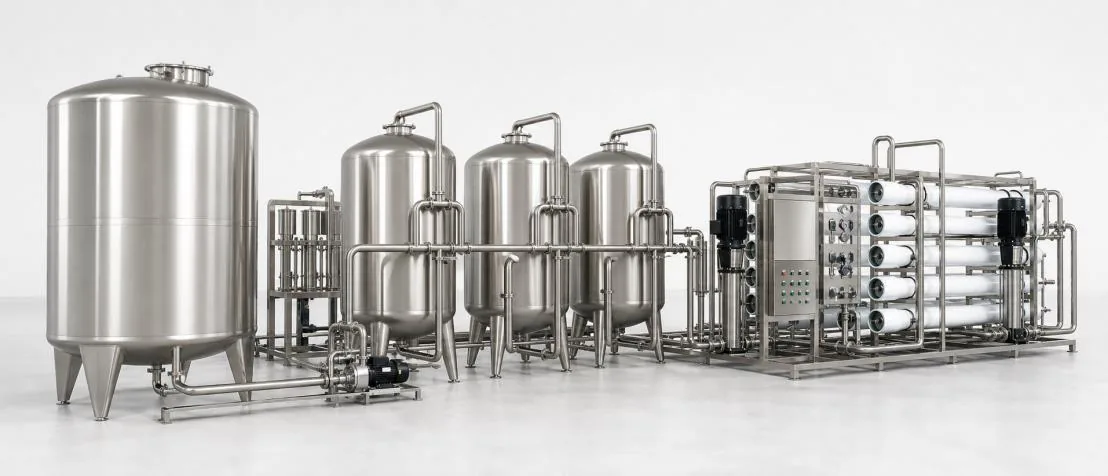
01
Natural mineral water has a specific definition in the Codex standard, including source characteristics and constraints on treatment. Use that distinction to organize the project, then establish the applicable product requirements in the market where the water will be sold.
| Project route | Primary design question | Equipment implication | Evidence to use |
|---|---|---|---|
| Natural mineral water | How will the defined source characteristics be protected through packaging? | Source collection and transfer plus only the justified, permitted treatment steps and hygienic bottling route | Source records, representative analysis, product-category basis and process description |
| Purified drinking water | Which source constituents must be reduced to achieve the intended finished-water quality? | A selected purification process, potentially RO, followed by suitable storage and bottling | Feed analysis, treatment objectives and finished-water acceptance criteria |
| Purified water with adjusted mineral composition | What final composition is intended and how will it be controlled? | The selected purification route plus justified adjustment, mixing and verification steps | Product specification, ingredient/process basis and applicable naming rules |
02
Treatment choice and packaging choice are separate decisions. The same source-water concept can lead to different bottle-supply, handling, filling and warehouse arrangements.
| Packaging decision | Plant configuration effect | Useful next input |
|---|---|---|
| Purchased PET bottles or onsite blowing | Select either protected empty-bottle supply or preform/blowing operations with their required services | Bottle drawing, neck/cap specification, volumes and sourcing preference |
| Still or sparkling product | The product condition changes filling, pressure-related equipment and container/closure requirements | Product description and intended carbonation condition for technical selection |
| One-way or returnable container | A returnable route adds receiving, inspection and a defined cleaning process before refilling | Container material, dimensions, return condition and distribution method |
| Retail multipacks or other delivery packs | Labels, coding, pack formation, pallet pattern and stock handling follow the destination channel | An example finished pack, bottles per pack and storage/dispatch plan |
03
Keep the hygienic path short, defined, sampleable and maintainable.
| Process area | Decision | Factory implication | Evidence |
|---|---|---|---|
| Source collection | Protected abstraction and transfer basis | Pump, pipe, buffer and access route | Source and flow records |
| Treatment | Only the justified and permitted operations | Skids, tanks, drains and service space | Approved process description |
| Storage | Holding time, sanitation and recirculation concept | Hygienic tank and vent arrangement | Inspection and sanitation records |
| Filling transfer | Closed route and connection responsibility | Pipe, valve, sampling and filler interface | Pre-startup checks and quality results |
04
Source status does not remove the need for process control, package checks and finished-product release.
Set the approved sampling, analysis and trend-review responsibilities for source and product characteristics.
Define room access, sanitation, environmental and in-process checks appropriate to the project and local requirements.
Check bottle condition, fill, cap application, label, code, pack and traceability at defined frequencies.
Create hold, investigation, correction, release or disposal routes before production begins.
05
A specific brief prevents a supplier from assuming that mineral and purified water use the same treatment basis.
| Input group | Information to provide |
|---|---|
| Source | Location, analysis, yield, variability, access and protection status |
| Product | Intended category, destination, treatment constraints and quality objectives |
| Packaging | Bottle, cap, label, code, pack, pallet and confirmed samples or drawings |
| Factory | BPH, shifts, site dimensions, utilities, drainage, rooms and logistics |
| Execution | Required engineering, documents, FAT, installation, training and target schedule |
R
The Codex standard supports the distinction between natural mineral water and other drinking-water routes. It is not a project approval; the requirements applicable to the source and selling market govern the final product and process.
Codex Alimentarius
Buyer questions
Not necessarily. Product definitions and permitted treatments differ by jurisdiction. Confirm the intended category and destination-market rules before fixing the process.
Do not assume so. RO changes dissolved constituents and may conflict with a product basis in some markets. The decision requires source, product and regulatory review.
The project may include source transfer, justified treatment, hygienic storage, bottle supply, rinsing-filling-capping, labeling, coding, packing, conveyors, utilities and quality-control support.
Prepare a source and product basis with representative analysis, destination-market category, treatment constraints and packaging plan before requesting a final equipment configuration.
Move this project question forward
Keep the hygienic path short, defined, sampleable and maintainable.
Not sure which data matters? Send what you have and state the decision you need to make.
Send target capacity and SKUs, source-water report, site utility schedule, building layout and required project milestones.
The project desk can identify missing inputs and a practical next step. Final engineering, configuration, compliance and commercial terms remain project-specific.
Allot Tech (Suzhou) Co., Ltd. · sales@allottech.com · Project telephone: +86 186 6213 1120 / +1 818 262 0958