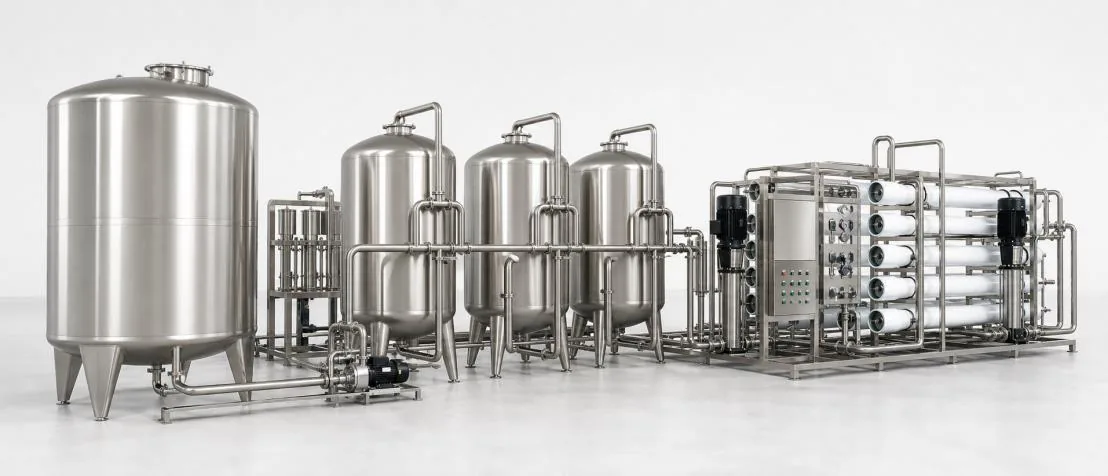
Water Bottling Plant Water Balance and Yield Planning
Saleable product is only one part of plant water demand. Treatment reject, filter backwash, bottle rinsing, tank and line cleaning, laboratory sampling, utility makeup, floor cleaning, sanitation and startup losses all affect the source, storage and wastewater boundary. A useful water balance connects each operating mode to measured or supplier-confirmed inputs and shows where assumptions must be verified during commissioning.
Catalog equipment reference for treatment-system planning. The final process follows raw-water evidence and the intended product.
01
Define the balance boundary and operating modes
Use one consistent unit and time basis so every source and destination can be reconciled.
Set the physical boundary
Identify source-water entry, treatment stages, hygienic storage, product transfer, filling, utility users, cleaning users, possible recovery loops and every discharge point. Mark meters and sampling points on the flow diagram.
Separate operating modes
Model normal production, startup, shutdown, changeover, sanitation, filter backwash, membrane cleaning, maintenance and idle preservation. Their flows and timing differ, so a single hourly average can hide a short peak.
Use a realistic production basis
Start with saleable bottles, fill volume, planned hours, format mix and expected scheduled activities. Keep unconfirmed losses visible instead of converting them into an apparently precise yield promise.
02
Create a source-and-destination register
Each line in the balance should have a basis, owner and verification method.
Water path
Planning input
Possible destination
Verification evidence
Product water
Saleable volume plus defined process losses
Filled product and controlled rejects
Filler count, level and product meter records
Treatment losses
Recovery, backwash, flushing and cleaning cycles
Recovery, treatment or approved discharge
Stage meters and operating logs
Cleaning and rinsing
Cycle volume, frequency and operating method
Drain, collection or approved reuse boundary
Procedure and measured cycle volume
Utility and building use
Cooling, boiler, air system, laboratory and sanitation demand
Recirculation, evaporation, product or discharge
Submeter and maintenance records
03
Use the balance to size interfaces and storage
The purpose is to reveal constraints, not to publish one theoretical efficiency number.
Source and treatment capacity
Compare source availability and treatment production with simultaneous product, cleaning and utility demand. Include storage operating range, replenishment time and the response to a source or treatment interruption.
Peak flow and drain capacity
Identify events that overlap, such as backwash, sanitation and floor cleaning. Provide source conditions and release scenarios to qualified local water and wastewater designers.
Recovery opportunities
Evaluate relatively clean streams only after quality, cross-connection, storage, treatment, controls and local approval are understood. A recovery concept should not create a hygienic or operating risk.
04
Reconcile the balance with operating data
Commissioning turns planning assumptions into a controlled baseline.
Meter readiness
Confirm meter location, range, units, accessibility, direction, calibration status, totalizers and data ownership before the performance observation begins.
Run defined observations
Record source, treated, product and major user totals across stable production and selected cleaning or backwash cycles. Note bottle format, output, stops and abnormal releases so ratios have context.
Investigate unexplained difference
Check timing, meter accuracy, tank-level change, overflows, leaks, rejected product, manual hoses and unmetered users. Maintain the balance as equipment, schedules or procedures change.
Buyer questions
Questions to settle before the next project gate
How much raw water is needed per bottle?
There is no universal ratio. Source quality, treatment process, recovery, rinsing, cleaning, utilities and operating practice all affect the project balance.
Is RO recovery the same as total plant yield?
No. RO recovery describes one treatment stage under defined conditions. Total plant yield also includes other treatment, cleaning, rinsing, utility and production flows.
Can reject water be reused?
Possibly, after its quality, flow, destination, cross-connection risk, storage, treatment and local approval have been evaluated for a defined use.
Which meters are most useful?
At minimum, plan measurement around the source, treatment production, product transfer and major loss or user streams, then refine the list from the actual balance.
Move this project question forward
Need to resolve Water Bottling Plant Water Balance and Yield Planning for your water bottling plant?
The purpose is to reveal constraints, not to publish one theoretical efficiency number.
Not sure which data matters? Send what you have and state the decision you need to make.
2. Attach the decision inputs
Set the physical boundary
Source and treatment capacity
Meter readiness
Separate operating modes
Send target capacity and SKUs, source-water report, site utility schedule, building layout and required project milestones.
3. Confirm the next planning step
The project desk can identify missing inputs and a practical next step. Final engineering, configuration, compliance and commercial terms remain project-specific.