Power and controls
Record connected and operating loads, protection, instruments, alarms and the interface to plant control.
Factory planning for water bottling projects
Use RO because the water and product require it
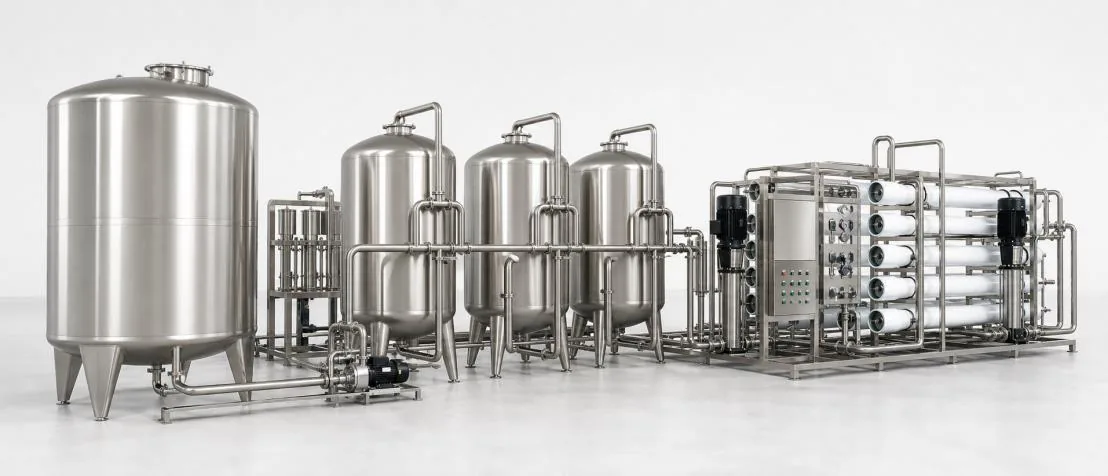
An RO water bottling plant combines a membrane treatment route with hygienic storage and a filling-and-packing line. RO separates feed water into permeate and concentrate. Source-water conditions determine pretreatment, while bottle output and operating hours determine the product-water requirement.
Answer first
First calculate product water from bottle volume and production rate, then add the other treated-water uses and compare treatment and bottling schedules. For the membrane stage, feed flow equals permeate flow divided by recovery. Source-water analysis and membrane design determine the recovery and pretreatment; a BPH label alone cannot select the RO package.
01
Choose a process that achieves the intended product-water quality and protects its downstream equipment. The following is selection logic, not a universal sequence or a claim that every module is included.
| Source or product condition | Configuration implication | Operating consequence |
|---|---|---|
| Suspended solids or variable turbidity | Select suitable upstream solids removal and filtration for the feed conditions | Provide backwash or filter replacement access and the associated wastewater route |
| Scaling or membrane-fouling potential | Design pretreatment and membrane operating conditions from the analysis | Recovery, cleaning and chemical handling affect both output and operating work |
| Dissolved-constituent reduction is needed | Evaluate RO with the specified feed and finished-water targets | Plan separate permeate and concentrate streams, pressure supply and membrane service |
| Finished-water composition requires adjustment | Evaluate a justified finishing step after the selected separation process | Include dosing/control, mixing and product verification where the design needs them |
| Water must remain protected before filling | Provide suitable hygienic storage, transfer and a validated sanitation/control route | Coordinate tank operation and cleaning with packaging stops and startup |
02
Illustrative arithmetic: assume the RO stage must supply 3,000 L/h of permeate and its approved design recovery were 75%. Feed would be 4,000 L/h and concentrate 1,000 L/h. The assumed recovery is not a recommendation or equipment guarantee; upstream backwash and other factory uses sit outside this membrane-stage example.
| Stream or allowance | Calculation or treatment | Illustrative result |
|---|---|---|
| RO permeate | Required treated-water output from this membrane stage | 3,000 L/h |
| RO feed | 3,000 ÷ 0.75 | 4,000 L/h |
| RO concentrate | 4,000 − 3,000 | 1,000 L/h |
| Other factory water | Add pretreatment losses, washing, cleaning and other users under their own schedules | Separate entries; no universal percentage assumed |
| Storage and operating hours | Compare hourly peaks and total daily production; design the hygienic storage duty | A buffer shifts timing but does not create water or remove quality controls |
03
Every tank, pump, treatment stage, sampling point and hygienic connection affects the bottling project.
| Stage | Planning purpose | Key interface | Evidence |
|---|---|---|---|
| Source and pretreatment | Stabilize feed conditions and protect downstream stages | Source pump, tanks, filters and dosing | Analysis and process basis |
| RO separation | Meet the agreed treatment objective | Feed pressure, permeate, concentrate and cleaning | Design conditions and operating readings |
| Post-treatment | Apply justified finishing and disinfection steps | Dosing, UV or ozone where selected | Target limits and verification method |
| Hygienic storage and transfer | Protect treated water before filling | Tank, vent, recirculation, pipe and filler connection | Sanitation and sampling plan |
04
Membrane treatment changes more than the water equipment list.
Record connected and operating loads, protection, instruments, alarms and the interface to plant control.
Provide safe storage, dosing, containment, handling procedures and locally compliant disposal arrangements.
Assign every reject, backwash and cleaning stream to a reviewed local discharge or handling route.
Allow membrane removal, filter replacement, tank access, instrument calibration and hygienic maintenance.
05
The treatment plant and filling line need one quality and traceability plan.
Define raw, intermediate, treated, filler and finished-product sampling based on the approved quality plan.
Record agreed pressures, flows, conductivity or other relevant process indicators and responses to deviation.
Define cleaning triggers, methods, release checks and restart conditions after stops or maintenance.
Send the water analysis, target product, required flow, operating schedule, site services, destination and complete packaging scope.
R
The EPA overview explains treatment methods and their selection factors. Project recovery, flow, finished-water limits and discharge arrangements follow the selected design and applicable local requirements.
US Environmental Protection Agency
Buyer questions
No. Treatment should follow source-water evidence, intended product and applicable requirements. RO may be appropriate for some purified-water projects and inappropriate or unnecessary for others.
Convert bottle formats and planned saleable output into product-water demand, then include treatment recovery, process uses, storage and operating schedules. Confirm the final design with project data.
It should be. Concentrate, filter backwash, cleaning and other non-product streams affect source demand, drainage and local environmental review.
Send representative water analysis, source availability, product objective, required output, operating hours, site utilities, room conditions, destination and the full bottling-line scope.
Move this project question forward
Every tank, pump, treatment stage, sampling point and hygienic connection affects the bottling project.
Not sure which data matters? Send what you have and state the decision you need to make.
Send target capacity and SKUs, source-water report, site utility schedule, building layout and required project milestones.
The project desk can identify missing inputs and a practical next step. Final engineering, configuration, compliance and commercial terms remain project-specific.
Allot Tech (Suzhou) Co., Ltd. · sales@allottech.com · Project telephone: +86 186 6213 1120 / +1 818 262 0958