Raw-water intake
Receive, store, sample and characterize the source water against the product and treatment basis.
Factory planning for water bottling projects
One controlled path from source to dispatch
The process combines two incoming streams - prepared water and clean containers - before filling, closure, labeling, packing, storage and dispatch.
Answer first
The water stream moves from source evaluation through the selected treatment, storage and transfer route. The container stream supplies protected purchased bottles or bottles made from preforms. They meet at filling and closure; coding, labeling and secondary packing then create the identified finished pack. Show cleaning, reject and quality-hold paths alongside the good-product route.
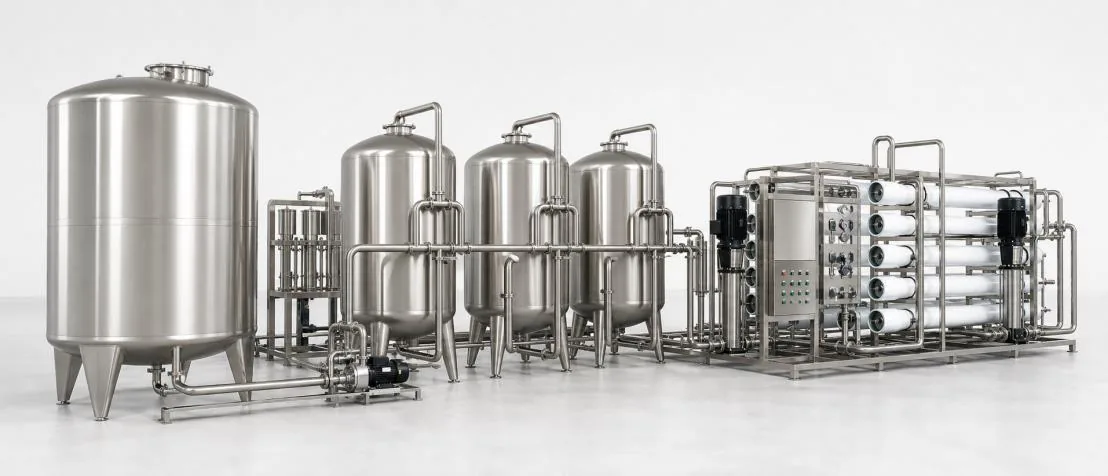
01
Both streams must reach filling under controlled conditions.
Receive, store, sample and characterize the source water against the product and treatment basis.
Apply the confirmed filtration, membrane, disinfection or mineral-control steps and verify the defined quality points.
Protect treated water in suitable tanks and piping with controlled cleaning, venting, drainage and sampling.
Blow or receive bottles, protect empty containers, feed caps and prevent uncontrolled contamination before closure.
02
Balance every machine around the confirmed container and output basis.
Handle containers, rinse where specified, fill to the agreed basis and apply closures with monitored operating settings.
Check container, fill, cap and code attributes according to the project quality plan and local traceability needs.
Apply the approved label, form the secondary pack and preserve product identification through downstream handling.
Move finished packs into controlled staging or pallets and manage warehouse rotation and dispatch routes.
03
Operating output is not the only acceptance measure.
Define sampling, tests, frequencies, limits, disposition of nonconforming product and record ownership.
Observe stops, accumulation, starvation and blockage across the complete line rather than rating the filler alone.
Document product-contact cleaning, external sanitation, format changes, restart checks and release responsibility.
Close training, manuals, spare parts, open actions and demonstrated operating conditions before routine production.
04
A realistic process map also shows sampling, rejects, waste, cleaning and recovery from abnormal conditions.
Track raw-water input, treatment recovery, reject or backwash streams, product-water storage and cleaning demand.
Identify preform, bottle, cap, label and finished-pack rejection points plus safe collection routes.
Show cleaning water or solution supply, return where applicable, discharge points and responsibility for local drains.
Define what must be checked after utility loss, machine stop, extended hold, maintenance or quality deviation.
05
A process is controllable when operators know the limit, the check, the response and the record.
| Process point | Planning question | Typical evidence category |
|---|---|---|
| Raw and treated water | What characteristics are monitored and at what stage? | Analysis, instrument reading and sampling record |
| Sanitation | What triggers cleaning and how is completion confirmed? | Procedure, concentration or condition record and release check |
| Container closure | How are cap application and package integrity verified? | In-process check and corrective-action record |
| Finished product | What releases or holds a production lot? | Test results, traceability and disposition record |
Buyer questions
No. Treatment follows source-water evidence and the product objective. The final process must be confirmed for the project and local requirements.
The filling and closure area is critical, but hygienic control also includes treated-water storage, transfer, container protection, cleaning and people practices.
Stops, bottle supply, labels, packing, utilities, changeovers, quality holds and operating practices can limit sustained line output.
They affect drains, waste handling, water demand, floor movement, product release and the time needed to recover stable production.
No. It is a starting point. Project documents must follow the confirmed raw water, product, treatment, container, equipment and local compliance requirements.
Move this project question forward
Share the source-water information, intended water product and container route. Include the bottle, label and shipping pack so the process review can trace each input to the finished product and identify missing interfaces.
Not sure which data matters? Send what you have and state the decision you need to make.
Send target capacity and SKUs, source-water report, site utility schedule, building layout and required project milestones.
The project desk can identify missing inputs and a practical next step. Final engineering, configuration, compliance and commercial terms remain project-specific.
Allot Tech (Suzhou) Co., Ltd. · sales@allottech.com · Project telephone: +86 186 6213 1120 / +1 818 262 0958