Reference and additional formats
State which bottle and pack define the performance test and what speed or limitations apply to other included formats.
Factory planning for water bottling projects
Industrial output requires factory-level coordination
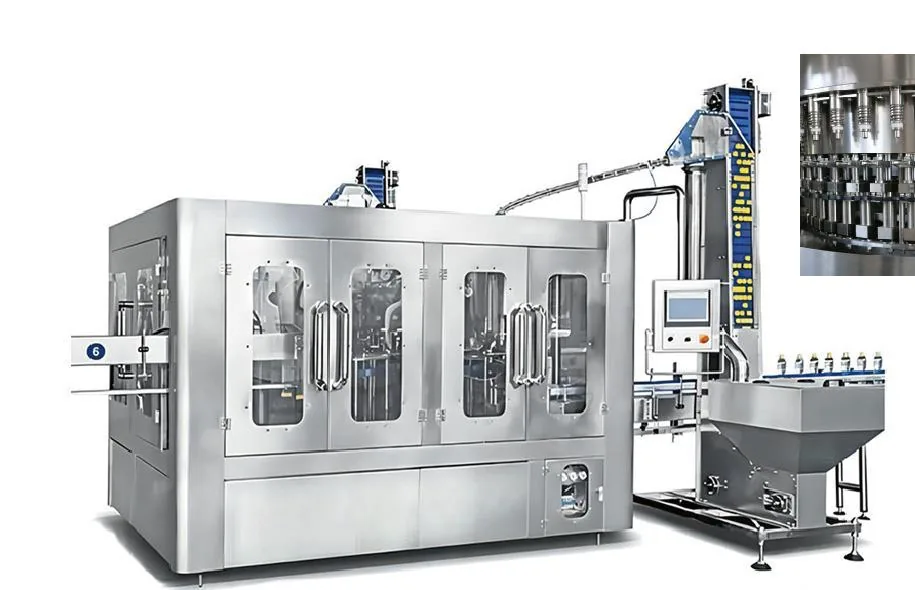
A 10,000-bottle-per-hour project should be evaluated as an integrated production system. Stable output depends on line balance, utilities, materials, operating discipline, maintenance access and the ability to move finished goods.
01
The project basis should show how saleable packs are produced under agreed conditions.
State which bottle and pack define the performance test and what speed or limitations apply to other included formats.
Separate individual-machine rating, line-design speed and the measurement used for an agreed performance test.
Show how conveyors and buffers respond to short downstream or upstream stops without creating damage or hygiene risk.
Agree counts, downtime classification, quality checks, utilities and material conditions used to evaluate the run.
02
Higher sustained output makes air, cooling, power and treatment capacity critical.
| System | Design questions | Evidence before startup |
|---|---|---|
| Product water | Treatment capacity, recovery, tanks, peak draw, sanitation and backup operating response? | Analysis, process basis, tank and connection checks |
| High-pressure air | Pressure, flow, quality, compressor staging, storage, cooling and safe distribution? | Selected blower loads and loaded-system test |
| Electrical | Total load, distribution, protection, power quality, grounding and recovery after interruption? | Approved load list, panels and measured supply |
| Cooling and environment | Heat loads, chiller duties, room ventilation and local climate effects? | Supplier duties and measured operating conditions |
03
A fast filler creates no value when materials cannot arrive or pallets cannot leave.
Calculate preform or bottle, cap, label, film, carton and pallet delivery by hour and shift, including changeover and staging.
Confirm pack formation, accumulation, pallet handling, rejects and the response when warehouse movement slows.
Translate daily output into pallet spaces, aisle movement, loading capacity and inventory days by the distribution plan.
Assign supervision, quality, material supply, sanitation, utilities, maintenance and fault response for each shift.
04
High output increases the value of clear maintenance and support arrangements.
Review isolation, guarding, access, lifting, cleaning, diagnostics, change parts and time to complete planned tasks.
Separate commissioning spares, normal wear parts, critical insurance spares and locally available standard components.
Define the production, stop and quality information required to find recurring losses without promising a specific efficiency.
Identify the commercial reason for redundancy, extra shifts or future modules and show what is included now versus reserved.
05
These figures are arithmetic planning examples, not promised output. Utilization combines scheduled time and operating losses for comparison; final saleable output depends on the confirmed bottle, materials, connected equipment, quality results and acceptance conditions.
| Illustrative schedule | Theoretical bottles | At 65% planning utilization | At 75% planning utilization | At 85% planning utilization |
|---|---|---|---|---|
| 8 scheduled hours | 80,000 | 52,000 | 60,000 | 68,000 |
| 16 scheduled hours | 160,000 | 104,000 | 120,000 | 136,000 |
Buyer questions
The output and operating model commonly support substantial automation, but the correct scope still depends on formats, labor, utilities, packing and commercial requirements.
Compressor quantity and architecture must follow confirmed pressure, flow, operating hours, maintenance and resilience requirements. A universal answer would be unsafe.
Define the measurement boundary, included and excluded stops, test duration, product, format, material quality, utilities and responsibilities in the technical agreement.
Use demand, utilization, format strategy, maintenance, business-continuity and expansion constraints rather than BPH alone.
For an illustrative 8-hour schedule, 10000 rated BPH equals 80,000 theoretical bottles. At 75% planning utilization the arithmetic result is 60,000 bottles before any separate quality loss assumption. Connected-machine balance and format-specific acceptance remain essential.
Move this project question forward
A fast filler creates no value when materials cannot arrive or pallets cannot leave.
Not sure which data matters? Send what you have and state the decision you need to make.
Send target capacity and SKUs, source-water report, site utility schedule, building layout and required project milestones.
The project desk can identify missing inputs and a practical next step. Final engineering, configuration, compliance and commercial terms remain project-specific.
Allot Tech (Suzhou) Co., Ltd. · sales@allottech.com · Project telephone: +86 186 6213 1120 / +1 818 262 0958