Bottle and fill conditions
Identify reference volume, bottle design, neck and cap, product conditions and the formats that must be tested.
Factory planning for water bottling projects
Balance the complete line around usable output
At a 5,000-bottle-per-hour planning level, an automatic line may provide a practical balance of output and investment, but only when bottle supply, downstream equipment, utilities and warehouse movement support the same operating plan.
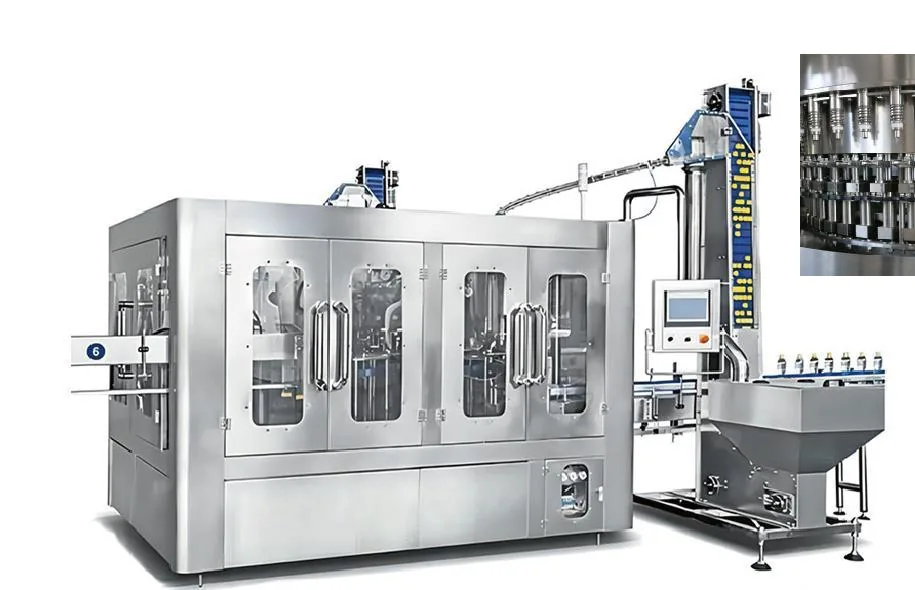
01
Use the same product, bottle and operating scenario when comparing proposals.
Identify reference volume, bottle design, neck and cap, product conditions and the formats that must be tested.
Distinguish filler nameplate speed from accepted, packed output after normal stops, rejects and changeovers.
Calculate base and peak needs from operating days, hours, planned utilization and inventory policy.
Require stated speeds and buffer logic for blowing or bottle feeding, filling, labeling, packing and pallet transfer.
02
Each package should have a clear upstream, downstream and utility boundary.
| Package | Scope questions | Integration risk |
|---|---|---|
| Treatment | Raw-water basis, treatment flow, recovery, storage and sanitation? | Insufficient stable product water or poorly defined local piping |
| Bottle supply | Purchased bottle or blower, molds, high-pressure air, cooling and transfer? | Bottle instability, storage congestion or air-system mismatch |
| Filling block | Rinse, fill, cap, hygiene, formats, controls and drainage? | Unclear product-contact and local connection boundaries |
| Downstream | Label, code, inspect, pack, convey, accumulate and hand off pallets? | Filler repeatedly stopped by an undersized end of line |
03
A medium-scale automatic line exposes weak services and logistics quickly.
Confirm total and package loads, starting behavior, protection, grounding, isolation and final connection ownership.
Separate service air and blowing air, and define pressure, quality, flow, storage, heat rejection and cooling interfaces.
Plan replenishment of preforms or bottles, caps, labels and film plus finished-pack, pallet and dispatch routes.
Provide access, change-part storage, spares, tools, sampling, laboratory functions, traceability and deviation control.
04
A speed promise needs specified conditions and evidence.
Agree which machines, formats, materials, utilities and durations can be tested before shipment and how open points are recorded.
Define readiness, product and packaging supply, line test conditions, measurements and responsibility for local systems.
Cover operation, cleaning, changeover, quality checks, fault response, maintenance and relevant documentation.
Transfer manuals, drawings, parts lists, programs or backups, records, spares and an agreed open-action register.
05
These figures are arithmetic planning examples, not promised output. Utilization combines scheduled time and operating losses for comparison; final saleable output depends on the confirmed bottle, materials, connected equipment, quality results and acceptance conditions.
| Illustrative schedule | Theoretical bottles | At 65% planning utilization | At 75% planning utilization | At 85% planning utilization |
|---|---|---|---|---|
| 8 scheduled hours | 40,000 | 26,000 | 30,000 | 34,000 |
| 16 scheduled hours | 80,000 | 52,000 | 60,000 | 68,000 |
Buyer questions
It must be defined. Ask whether the number applies to a reference bottle at the filler or to an agreed integrated-line test and operating condition.
It may be appropriate, but the decision depends on bottle supply, preform economics, high-pressure air, cooling, power, skills, storage and expansion.
All must be balanced. Labeling, coding, packing, conveyors and pallet handling can each constrain saleable output if selected independently.
Final area follows the confirmed arrangement, utilities, clearances, storage, movement and future plan. BPH alone cannot produce a responsible square-meter figure.
For an illustrative 8-hour schedule, 5000 rated BPH equals 40,000 theoretical bottles. At 75% planning utilization the arithmetic result is 30,000 bottles before any separate quality loss assumption. Confirm the final basis with the selected line.
Move this project question forward
A medium-scale automatic line exposes weak services and logistics quickly.
Not sure which data matters? Send what you have and state the decision you need to make.
Send target capacity and SKUs, source-water report, site utility schedule, building layout and required project milestones.
The project desk can identify missing inputs and a practical next step. Final engineering, configuration, compliance and commercial terms remain project-specific.
Allot Tech (Suzhou) Co., Ltd. · sales@allottech.com · Project telephone: +86 186 6213 1120 / +1 818 262 0958